

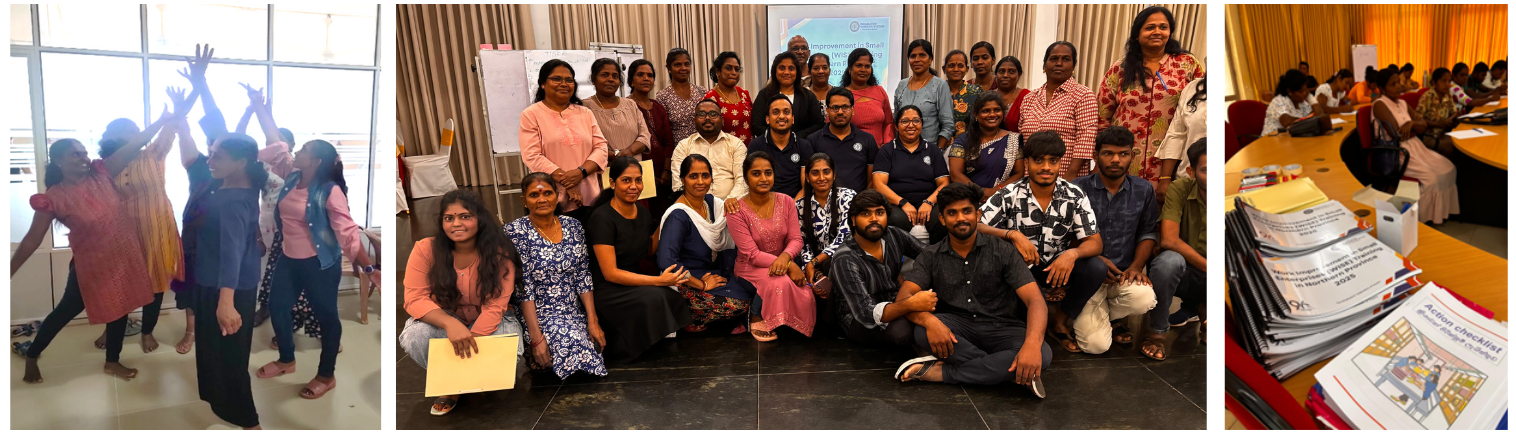
Strengthening Occupational Safety and Health for MSMEs in the Northern Province through the ILO–WISE Programme Conducted by the Employers’ Federation of Ceylon
Promoting Advancement of Vulnerable Persons and Enterprises (PAVE) project is developed to address economic challenges in the Northern Province of Sri Lanka, focusing on poverty reduction and sustainable growth through enterprise development, private sector investment, and digitalization. The project, funded by the Government of Norway, targets marginalized women heads of households and persons with disabilities.
The Work Improvement in Small Enterprises (WISE) Programme of the International Labour Organization (ILO) provides practical tools and training to improve working conditions, productivity, and gender equality in small enterprises. Building on this framework, the project titled “Contextualization and Delivery of ILO’s Work Improvement in Small Enterprises (WISE) Training in the Northern Province” was conducted during the period 27 October 2025 to 30 November 2025.
The project was designed to contextualize the ILO WISE tool and deliver targeted training to Micro, Small and Medium Enterprises (MSMEs) in the Northern Province, with particular attention to local Occupational Safety and Health (OSH) challenges, cultural considerations, and business realities. The training was delivered directly to enterprises to ensure practical and measurable improvements in workplace safety, operational efficiency, and inclusivity.
The primary objective of this consultancy was to work in close coordination with the ILO and the Small Enterprise Development Division (SEDD) to adapt the WISE training materials and support MSMEs in strengthening their OSH practices. The project aimed to address common OSH challenges faced by MSMEs in the Northern Province, including limited awareness of workplace hazards, inadequate safety measures, and insufficient knowledge of best practices.
The project utilized the ILO’s WISE Manual (Work Improvement in Small Enterprises) as a key training tool. The manual provides MSMEs with simple, low-cost, and easy-to-implement solutions to improve safety, health, and working conditions. These improvements also contribute to enhanced productivity and efficiency, while encouraging active participation and cooperation among workers within the workplace.
The training assignment focused on two specific objectives:
- Review and contextualisation of training materials, through assessment and adaptation of existing WISE content based on a needs assessment of MSMEs in the Northern Province, ensuring relevance to the local socio-economic and cultural context; and
- Facilitation of training for selected enterprises, equipping participants with the knowledge and skills required to effectively implement WISE practices in their businesses.
During the reporting period, several key outputs were achieved. The WISE training materials were translated from English into Tamil and Sinhala, ensuring accessibility and inclusivity for participants. In addition, three training programmes were successfully conducted across the Vavuniya and Mullaitivu Districts, targeting 100 participants. To ensure effective communication and participation, the training sessions were delivered with the support of a Tamil language interpreter.
The project was implemented by a dedicated training team comprising Ms. Gaya Kariyawasam, Manager – Occupational Safety and Health, Mr. Chamith Premarathna, Senior HR Advisor and Mr. Lahiru Opatha, Industrial Relations Advisor whose collective expertise contributed to the success of the programme.
Through this initiative, the project contributed to improving occupational safety and health standards, strengthening productivity, and promoting sustainable and inclusive enterprise development among MSMEs in the Northern Province.